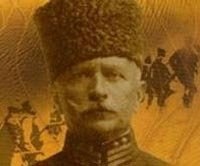
Fahreddin Paşa is one of the last army commanders of the Ottoman era. He was also known as the “Defender of Medina” and “Desert Tiger”
Fahreddin Paşa was born in 1868 in Russe (TR: Rusçuk) which is in current-day Bulgaria, at the bank of the Danube, as the son of Mehmed Nahid Bey and Fatma Adile Hanım. His family moved to Istanbul during the Turco-Russian War in 1878. As he was studying at the War Academy, he took private lessons in French and photography. In 1888, he graduated from the Academy and three years later, he completed the Staff School, at the rank of Captain.
His first post was at the Fourth Army in Erzincan, where he rose to the rank of Lieutenant Colonel and fought against the Armenian gangs raiding the Turkish infantry regiments. In 1908, when he was the Deputy Chief of Staff of the Fourth Army, the Constitution was proclaimed, and he returned to Istanbul, where he became the Chief of Staff of the 1st Regular Division.
Fahreddin was one of the Turkish officers who went to Libya in 1911-1912 to fight against the Italians and when the Balkan War broke out, he was appointed as the commander of the 31st Division in Gallipoli. His unit played a key role in recapturing Edirne from the Bulgarians and on 22 July 1913, he was commanding the Turkish units entering the town with Enver Paşa.
In 1914, before the Turkish Army was ordered to mobilize, Fahreddin became the commander of the XII Corps in Mosul. He did not stay there long, he was promoted to a General on 12 November 1914 and later on, he was appointed as the Deputy Commander of the Fourth Army in Aleppo.
On 23 May 1916, upon the orders of Cemal Paşa, Fahreddin Paşa moved to Medina with a group of officers. A few days later, the “Arab Revolt” broke out, when the sons of the Emir of Mecca, Sherif Hussein, raided the Turkish military stations. Fahreddin Paşa undertook the task of defending Medina and its holy sites against the rebelling Arabs and the British. He took over the command of the “Hejaz Expeditionary Force” on 17 July 1916 and organized the successful defense of the holy town. On 14 May 1917, being aware of the threat, he ordered all the holy relics in Medina, included some personal belongings of Prophet Muhammad, to be packaged and transferred to Istanbul on a special train.
When the armistice was signed on 30 October 1918, the legendary Hejaz Expeditionary Force was asked to surrender. The “Desert Tiger” refused and insisted to stay in Medina to protect the town. Finally, on 10 January 1919, some of his officers seized him by force, and handed over to the British.
After a brief stay in Cairo, Fahreddin Paşa was sent to Malta as a prisoner of war. His captivity ended on 30 April 1921 and he was sent to the port of Taranto in Italy, from where he returned to the homeland.
On 27 October 1921, the Turkish Grand Assembly appointed Fahreddin Paşa as the Turkish Ambassador to Kabul, Afghanistan. He was very successful as a diplomat and he organised the Afghan support for the War of Independence in Turkey. He returned to Turkey in 1926 and became first a member, then the chairman of the Military Court Council. He retired in 1936.
On 22 November 1948, as he was traveling by train from Istanbul to Ankara, Fahreddin Paşa had a stroke. He died at the age of 80.
Kronoloji / kayıt
Kayıt
2025-08-15 03:24:41